Why Your Study Techniques Are Failing You
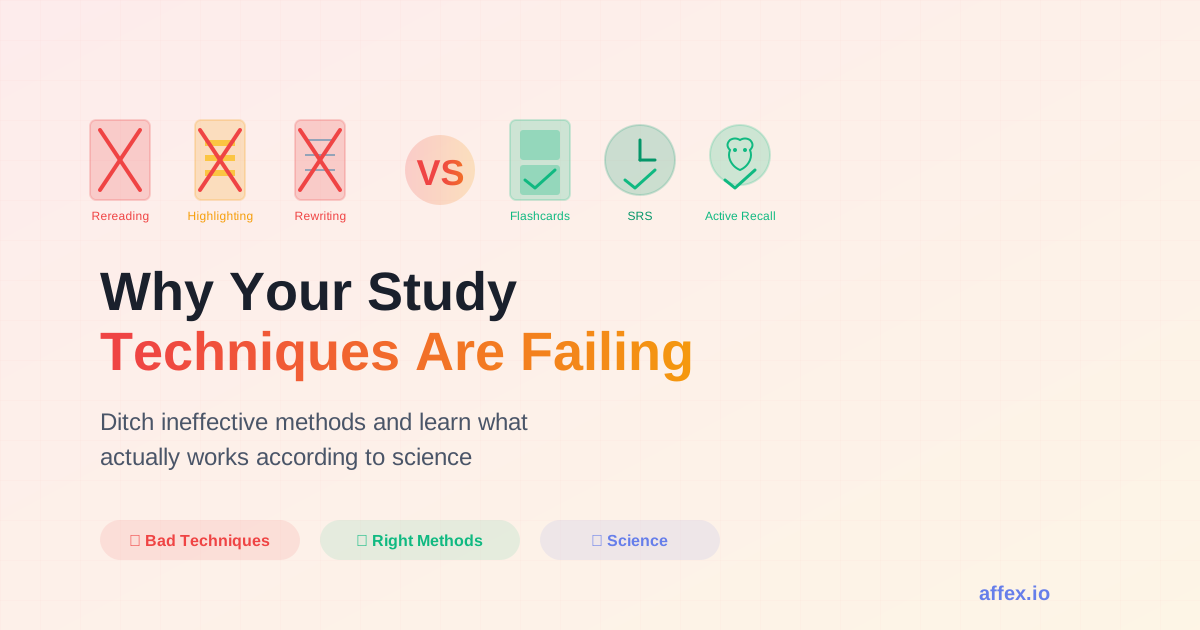
You spend hours studying, highlight entire pages, re-read your notes… and blank out during the exam? The problem isn’t your intelligence — it’s your strategy. Most study techniques are scientifically ineffective. Discover the 5 biggest myths and what to do instead.
Table of Contents
- 1. The Myth: Re-reading Your Notes
- 2. The Myth: Highlighting Everything
- 3. The Myth: Cramming
- 4. The Myth: Blocked Practice
- 5. The Myth: Passive Listening
- Your New Study Routine
- Frequently Asked Questions
- Conclusion
1. ❌ The Myth: Re-reading Your Notes
Why it fails: Re-reading is passive. Requires zero cognitive effort. Your brain glides over the words saying “yes, I know this”. But you’re not building neural pathways — just refreshing short-term memory.
✅ The Fix: Active Recall
Close the book. Put away notes. Ask: “What did I just read?”
Force your brain to retrieve information from scratch. This effort encodes memory.
Affex Tip: Turn key concepts into flashcards immediately. Creating the card is already the first active recall.
2. ❌ The Myth: Highlighting Everything
Why it fails: Highlighting feels like work, but it’s just coloring. Research shows zero correlation between highlighting and retention. Focuses on isolated facts, not the big picture.
✅ The Fix: Feynman Technique
Can you explain the concept to a 5-year-old? If not, you haven’t understood it yet.
Affex Tip: Use the back of flashcards to write simple explanations (1 sentence), not textbook definitions.
3. ❌ The Myth: Cramming (“The All-Nighter”)
Why it fails: Your brain needs sleep to consolidate memories. Cramming stuffs short-term memory, which empties after the exam. It’s stressful, exhausting, and temporary.
✅ The Fix: Spaced Repetition
Spread your sessions. 30 min/day for 10 days > 5 hours in 1 day.
Affex Tip: 15 minutes in the app every morning. The algorithm ensures you review what you need, preventing pre-exam panic.
4. ❌ The Myth: Blocked Practice (Studying One Subject All Day)
Why it fails: 6 hours of one subject = cognitive fatigue and diminishing returns. Your brain gets bored and stops creating connections.
✅ The Fix: Interleaving
Mix subjects. 45 min History → 45 min Biology → 45 min language.
Forcing your brain to constantly reload context strengthens flexible thinking.
Affex Tip: Create a “Mixed Deck” or review your “Due Today” queue, which naturally interleaves cards from different topics.
5. ❌ The Myth: Passive Listening
Why it fails: Attending class without acting = rapid forgetting. Studies show we lose 90% of what we hear in 1 week if we don’t interact.
✅ The Fix: Cornell Method + SRS
Take notes that force summary and questioning. Same day, transfer critical points to Affex.
Affex Tip: Treat notes as “staging area”. Passive notes → portable active study system.
5 Techniques That Actually Work
- Active Recall (flashcards)
- Spaced Repetition (Affex SRS algorithm)
- Interleaving (mix subjects)
- Self-testing (practice questions)
- Elaboration (explain in your own words)
Your New Study Routine
Morning: Review flashcards in Affex (interleaved, all subjects) — 15-20 min
Afternoon: Learn new material with active notes (Cornell Method)
Night: Create new flashcards in Affex about what you learned
Weekly: Self-test with past questions or simulations
Frequently Asked Questions
Does re-reading never work?
Re-reading can be useful on the first pass to understand material. But as a review technique, it’s ineffective. Use active recall.
Does highlighting have any value?
Yes, if minimal and strategic. Highlight only 2-3 key sentences per page. Then transform into questions/flashcards.
How long does it take to change study habits?
21-30 days of consistent practice. Starting small (15 min/day) is better than starting big and quitting.
Can I combine old techniques with new ones?
Yes! Use mind maps (visual) + flashcards (recall). Or Cornell notes + spaced repetition. The secret is turning passive into active.
Is Affex better than studying with summaries?
Complementary. Summaries help understand. Flashcards with SRS record permanently. Use both.
Conclusion
Stop working harder. Start working smarter.
Trade passive habits (re-reading, highlighting) for active strategies (recall, spaced repetition). Result: half the time, double the retention.
Affex automates the science. You focus on learning.